A small selection of my work from the past few decades…

There's a lot to showcase, so here are just a few select projects discussing Design Systems and Foundations, Content Management Creation, Researching and Designing for new and non-traditional interfaces, and the perfect Design Process.


ELEKTA:

DESIGN SYSTEMS AND FOUNDATIONS

Helping clinicians treat more cancer patients with increased quality, precision and speed.

Elekta turned the experimental treatment of cancer with radiation - radiotherapy - on its head with the invention of the Gamma Knife in 1972. Now as it moves into the 21st century it’s entering a new, digital transformation, with the marriage of software and hardware instrumental to its future - and the future of cancer treatment across the world.

I joined Elekta in January of 2021 at the very start of the transformation process. My role was to lead a new UX team of eight members - across four continents and five timezones -and to develop the UX/Design processes whilst also developing the new user interface for an entirely new line of product - the first integrated MRI-Linac (Linear Accelerator) with protocol driven treatment methods.

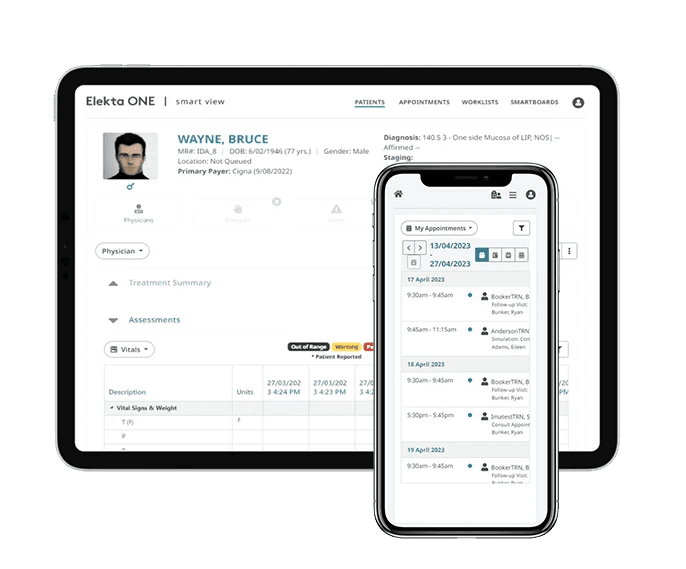
The power behind the new system is an integrated Treatment Session Manager suite of applications that enable a complete transformation of the clinician’s usual environment of multiple computers, monitors and input devices, by allowing for a process-driven software interface to be guided from a single machine, a single mouse and - when infrequently required - a keyboard for text input.

As this is a machine that administers radiation, the regulatory requirements are - as you can imagine - extremely rigid, and differ from territory to territory, so alongside the specific user requirements gathering phase, there is a huge amount of detailed investigation to be completed before work can even begin on a design in earnest.

Hardware and software has been subjected to rigorous usability testing - both as separate components but also from a Human Computer Interaction perspective and as we reach the final six months of development, the outcomes are already looking extremely positive; we’ve successfully managed to reduce patient to treatment time dramatically, whilst also rapidly increasing patient throughput through the simplification of our pre-treatment delivery interface design.
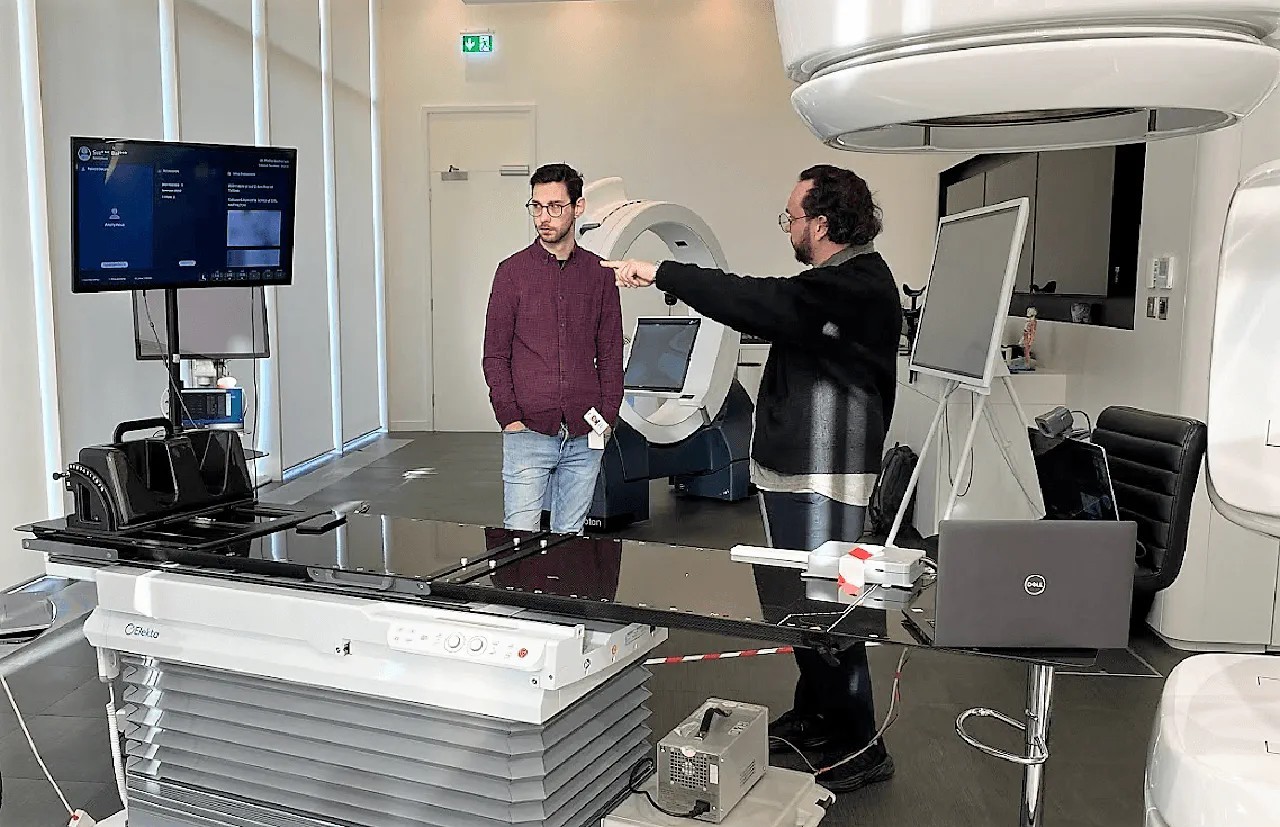

“Speed up the time of use, increase patient throughput, save more lives. Simple.”

The key to our success has been the development - from scratch - of our Design System. Starting with a thorough investigation into the process of design alongside the requirements of all the stakeholders, the outcome of our design system implementation has been a huge success. Prior to development, Elekta maintained several design and development teams in disparate business lines with little or no communication between them.

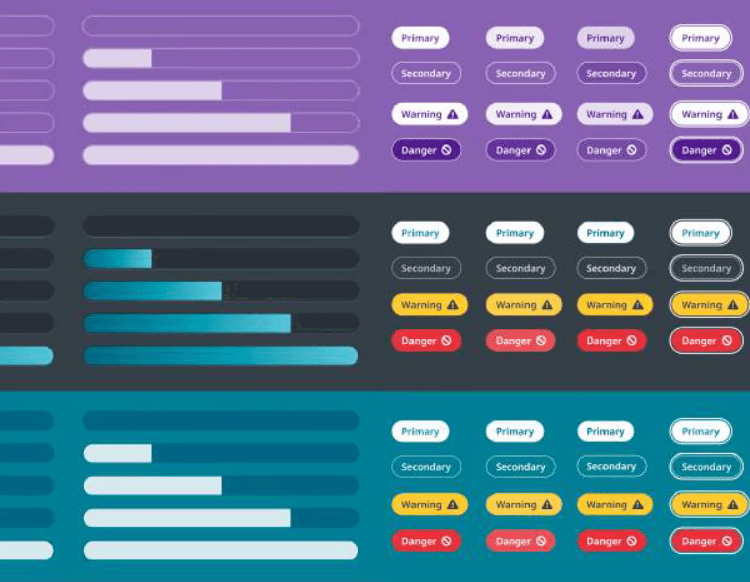
Now, with a concerted effort of both ‘design community outreach’, requirements gathering and process-led design production, the Elekta Component Library is now shared - via Figma - with designers across the globe, and developers - via StoryBook - in multiple countries.

Instrumental to the system’s success has been the ‘process design’. Each element of the system is born first from a design suggestion or request which is then triaged and taken into one of several, iterative design stages; covering everything from criteria acceptance, wireframe and prototyping, peer-review and component library release - before being developed and then released globally to a teams of developers for use within their interface production.

As part of this development, the central programme team researched and developed five, core UX principles that form the foundation of all of our design work:

  • Contextual UI – reflecting precise role and permissions of the current user.

  • Workflow & Protocol-based experiences – the system understands what is needed now and next.

  • 90% of usage drives design – provide paths to exceptions, but don’t make them mainstream.

  • One single destination – all tasks can be met from the one starting point.

  • Modular UI – we build simple but powerful things once and use them in many places.

Elekta has progressed from a fragmented and incommunicative set of designers, developers and products, to being on the cusp of releasing its first, full suite of integrated system applications - the Elekta Oncology Network - which has both increased the efficacy of cancer care worldwide, but also allows the business to pivot into a providing a full-scale, software application business model for its many hospitals


“Speed up the time of use, increase patient throughput, save more lives. Simple.”

The key to our success has been the development - from scratch - of our Design System. Starting with a thorough investigation into the process of design alongside the requirements of all the stakeholders, the outcome of our design system implementation has been a huge success. Prior to development, Elekta maintained several design and development teams in disparate business lines with little or no communication between them.

Now, with a concerted effort of both ‘design community outreach’, requirements gathering and process-led design production, the Elekta Component Library is now shared - via Figma - with designers across the globe, and developers - via StoryBook - in multiple countries.

Instrumental to the system’s success has been the ‘process design’. Each element of the system is born first from a design suggestion or request which is then triaged and taken into one of several, iterative design stages; covering everything from criteria acceptance, wireframe and prototyping, peer-review and component library release - before being developed and then released globally to a teams of developers for use within their interface production.

As part of this development, the central programme team researched and developed five, core UX principles that form the foundation of all of our design work:

  • Contextual UI – reflecting precise role and permissions of the current user.

  • Workflow & Protocol-based experiences – the system understands what is needed now and next.

  • 90% of usage drives design – provide paths to exceptions, but don’t make them mainstream.

  • One single destination – all tasks can be met from the one starting point.

  • Modular UI – we build simple but powerful things once and use them in many places.

Elekta has progressed from a fragmented and incommunicative set of designers, developers and products, to being on the cusp of releasing its first, full suite of integrated system applications - the Elekta Oncology Network - which has both increased the efficacy of cancer care worldwide, but also allows the business to pivot into a providing a full-scale, software application business model for its many hospitals

BT SPORT:

CONTENT MANAGEMENT & CREATION

Designing a technical and strategic transition.

When BT Sport launched in 2013 it was to be the spearhead of an entirely new business arm for BT - but whilst the broadcast infrastructure and technology used to deliver the UltraHD sport channels was state-of-the-art, the website publishing architecture that was present to support it was not.

BT was stuck on an old content management system and with display ads taking prominent space within an old ‘portal-like’ architecture left over from its legacy Yahoo! days.

Jump forward several years later and with billions of pounds invested, the already-creaky CMS was in dire need of an update to reflect the wealth of product on offer.

The first piece of work undertaken was an extensive piece of Investigation & Discovery.

Qualitative and quantitative research was conducted with customers using a variety of methods; looking into everything from their expectations of a BT homepage right through to their opinion of video-based editorial within BT Sports’ various touch-points across the BT ecosystem.

One of the largest problems encountered by our audience was the apparent confusion brought about by the inclusion of display advertising across the entire BT real estate - and especially within the homepage. This led to a wealth of - healthy - discussion across the business as we sought to collectively calculate the impact the removal of such a stream of obvious revenue would bring.

Whilst we would continue to design with advertising in mind within the BT Sport specific pages, an early decision was made to remove all advertising from the BT Homepage and this became the first piece of real-estate to get the new CMS treatment (Adobe Experience Manager).


World class data delivery for a world leading service.
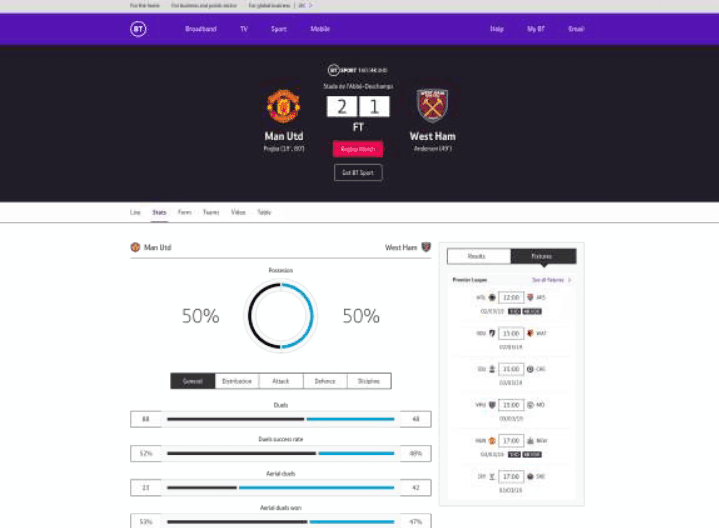
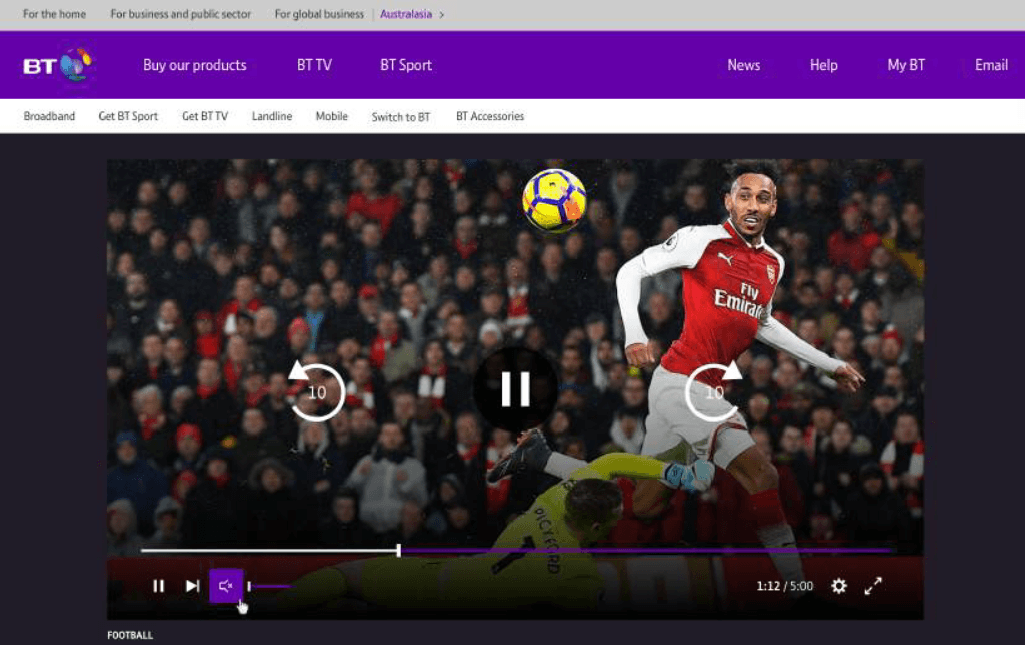
As more and more BT Sport customers become encouraged to ‘second-screen’ and to interact with content across the many interconnected social-media platforms and content channels that the broadcaster operates upon, the need for a website that truly reflects the myriad content - and device - types through which everything is accessed is paramount.

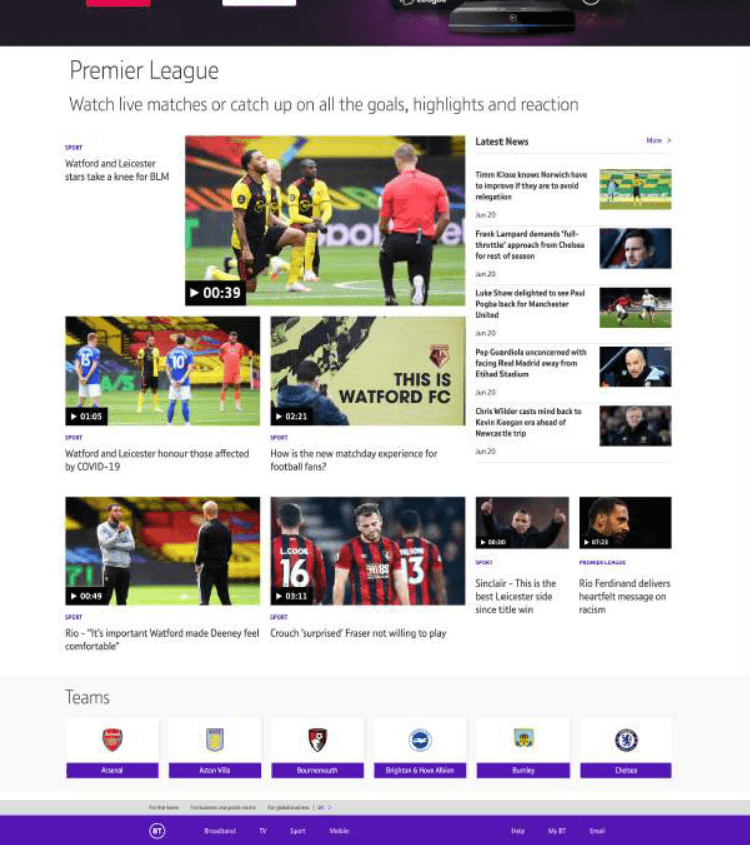
From fixtures and results, to match data, to broadcast-related media updates and beyond, the new BT Sport site infrastructure allows for modular - and granular - updating dynamically as and when required.

"Responsive and Reactive"

Fixture, team and score data all seamlessly powers automatic generation of match day pages well in advance of kickoff - vital for SEO seeding - and it all ties in with the vital up-selling and cross-selling of BT Sports channels and services.

The entire project was research-driven, with an extensive design lead being taken from dozens of in-depth user interviews and research sessions which were coded, formulated and the results - as well as proposals - taken to the various stakeholders across the business at every stage of the process.

As both Research Lead and the Product Design Manager, my role was to facilitate, to translate and to architect and illustrate every stage of the journeys and every page template and component.

Launched in June of 2020, page views were immediately increased and dwell/read times and engagement became exponentially greater.

As more and more BT Sport customers become encouraged to ‘second-screen’ and to interact with content across the many interconnected social-media platforms and content channels that the broadcaster operates upon, the need for a website that truly reflects the myriad content - and device - types through which everything is accessed is paramount.

From fixtures and results, to match data, to broadcast-related media updates and beyond, the new BT Sport site infrastructure allows for modular - and granular - updating dynamically as and when required.

"Responsive and Reactive"

Fixture, team and score data all seamlessly powers automatic generation of match day pages well in advance of kickoff - vital for SEO seeding - and it all ties in with the vital up-selling and cross-selling of BT Sports channels and services.

The entire project was research-driven, with an extensive design lead being taken from dozens of in-depth user interviews and research sessions which were coded, formulated and the results - as well as proposals - taken to the various stakeholders across the business at every stage of the process.

As both Research Lead and the Product Design Manager, my role was to facilitate, to translate and to architect and illustrate every stage of the journeys and every page template and component.

Launched in June of 2020, page views were immediately increased and dwell/read times and engagement became exponentially greater.

ROYAL ENFIELD:

RESEARCH & DESIGN FOR NEW & NON-TRADITIONAL INTERFACES

Developing new interactions for a new breed of motorcycles - whilst maintaining support for the old guard.
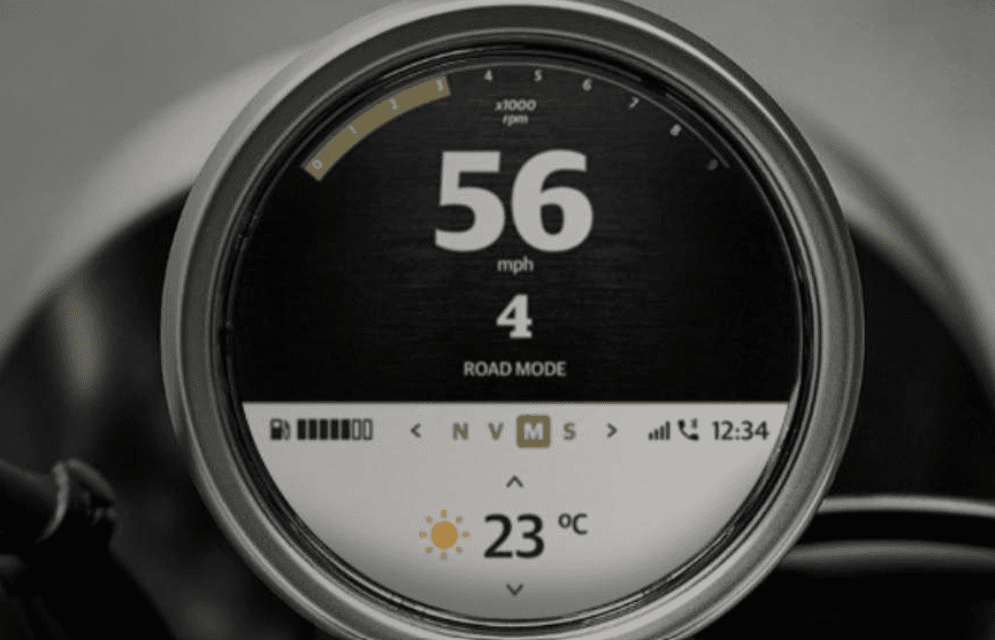
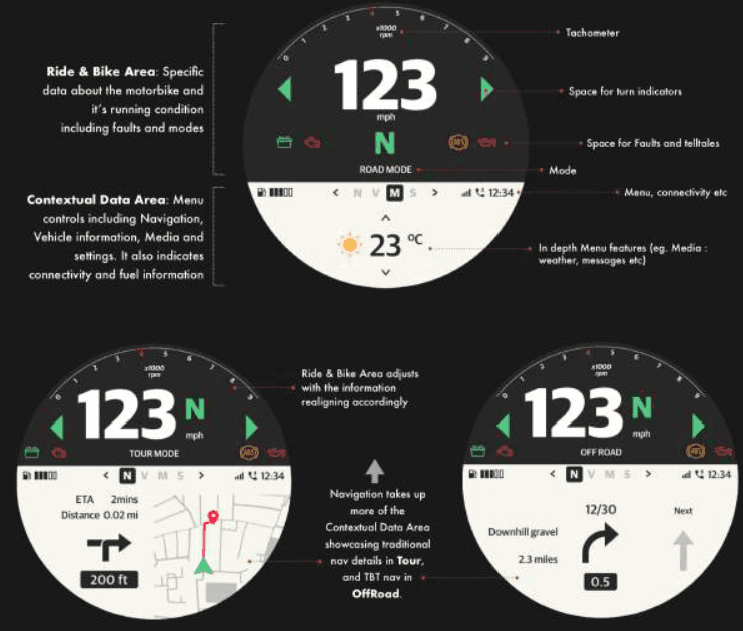
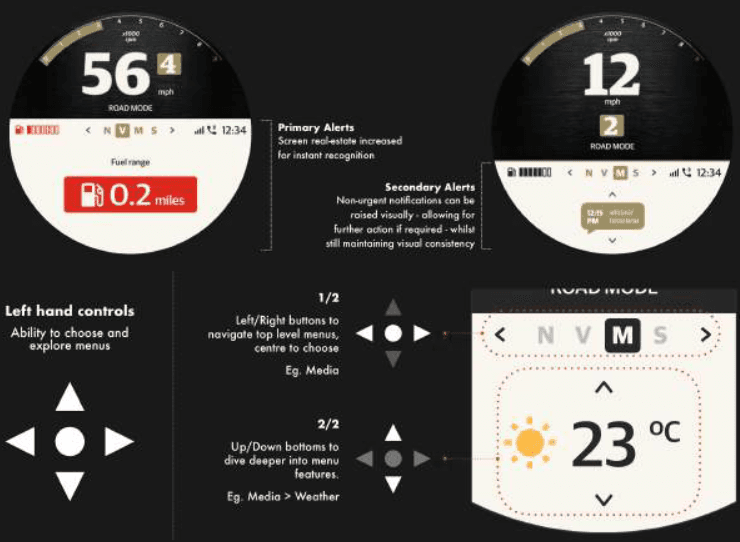
Facilitating freedom and joy through interface design.

Royal Enfield are known for the traditional. With a history that dates back to over a century, the British-born, Indian-owned motorcycle brand have seen a resurgence under their billion dollar owner over the past decade.

But with powered two-wheeler riding across the world being challenged by the advance of technology and the decline of petrol-powered vehicles, a challenge was set to investigate the future of one of the most iconic ‘Human to Machine interfaces’ in the world.

An investigatory plan was developed and soon after, what is believed to be the worlds’ most extensive research project into motorcycle technology use was completed.

Taking the form of qualitative interviews with motorcycle/scooter riders of all demographics, coupled with a qualitative research survey seeded out to riders from over 45 countries, a White-paper was authored, the goal of which was to take a step back, to take a breath and to examine what it is that motorcycle and scooter riders actually want from their rides, and how technology use can enhance - or potentially hinder - that experience.

The research was undertaken in order to help both identify and to develop a series of design ‘jump off’ points from which we could begin to explore the opportunities - and avoid the dangers - that the merging of navigation, communication and advancing technologies can bring to the riding experience.


Facilitating freedom and joy through interface design.

Royal Enfield are known for the traditional. With a history that dates back to over a century, the British-born, Indian-owned motorcycle brand have seen a resurgence under their billion dollar owner over the past decade.

But with powered two-wheeler riding across the world being challenged by the advance of technology and the decline of petrol-powered vehicles, a challenge was set to investigate the future of one of the most iconic ‘Human to Machine interfaces’ in the world.

An investigatory plan was developed and soon after, what is believed to be the worlds’ most extensive research project into motorcycle technology use was completed.

Taking the form of qualitative interviews with motorcycle/scooter riders of all demographics, coupled with a qualitative research survey seeded out to riders from over 45 countries, a White-paper was authored, the goal of which was to take a step back, to take a breath and to examine what it is that motorcycle and scooter riders actually want from their rides, and how technology use can enhance - or potentially hinder - that experience.

The research was undertaken in order to help both identify and to develop a series of design ‘jump off’ points from which we could begin to explore the opportunities - and avoid the dangers - that the merging of navigation, communication and advancing technologies can bring to the riding experience.


Context is everything. The joy of the ride is everything.

With regards to the usage of interfaces and technology as a whole, context is everything to a motorcyclist. Participants across the board responded at great length about conducting different activities at different times, depending upon their circumstances at any particular moment; whilst stopped they would often be planning the next part of their ride, or taking that time to make a call or communicate, but whilst riding they required focus, with little to no distraction. But even the type of riding being undertaken is important.

There is a significant enough difference between the desires of riders when they are stationary compared to when they are actually riding to consider designing a ‘focused’ experience for whilst they are actively engaged in the ride, compared to a more ‘feature rich’ experience whilst they are stationary.

Respondents who ride longer distances (on motorway or highway rides for example) are far more comfortable with listening to music - as it helps them maintain attention whilst riding - than those on tighter, more concentrated journeys - such as a commute to work.

These commuter-type riders expressed a far stronger desire to be able to make contact quickly and easily rather than spend time selecting and listening to a music playlist or specific song.

And then there are those riders who want nothing but a pure, riding experience, free from any interference or digital interaction - unless it’s that one important phone-call or that perfect, ‘canyon-carving’ soundtrack; riding is personal and a persons’ context is very particular to an individual and their specific circumstances.

"Bikes are very much seen as a reflection of a riders’ personality"

Ran through an independent research and design company that I setup explicitly for this project, the User Experience and User Interface framework and pattern library that was supplied to Royal Enfield is now expected to form the visual and interaction language that will feature in all of their upcoming petrol - and electrically -powered motorcycles from 2026 and beyond.


Context is everything. The joy of the ride is everything.

With regards to the usage of interfaces and technology as a whole, context is everything to a motorcyclist. Participants across the board responded at great length about conducting different activities at different times, depending upon their circumstances at any particular moment; whilst stopped they would often be planning the next part of their ride, or taking that time to make a call or communicate, but whilst riding they required focus, with little to no distraction. But even the type of riding being undertaken is important.

There is a significant enough difference between the desires of riders when they are stationary compared to when they are actually riding to consider designing a ‘focused’ experience for whilst they are actively engaged in the ride, compared to a more ‘feature rich’ experience whilst they are stationary.

Respondents who ride longer distances (on motorway or highway rides for example) are far more comfortable with listening to music - as it helps them maintain attention whilst riding - than those on tighter, more concentrated journeys - such as a commute to work.

These commuter-type riders expressed a far stronger desire to be able to make contact quickly and easily rather than spend time selecting and listening to a music playlist or specific song.

And then there are those riders who want nothing but a pure, riding experience, free from any interference or digital interaction - unless it’s that one important phone-call or that perfect, ‘canyon-carving’ soundtrack; riding is personal and a persons’ context is very particular to an individual and their specific circumstances.

"Bikes are very much seen as a reflection of a riders’ personality"

Ran through an independent research and design company that I setup explicitly for this project, the User Experience and User Interface framework and pattern library that was supplied to Royal Enfield is now expected to form the visual and interaction language that will feature in all of their upcoming petrol - and electrically -powered motorcycles from 2026 and beyond.

BBC:

THE PERFECT DESIGN PROCESS

A Flagship Homepage Redesign Project
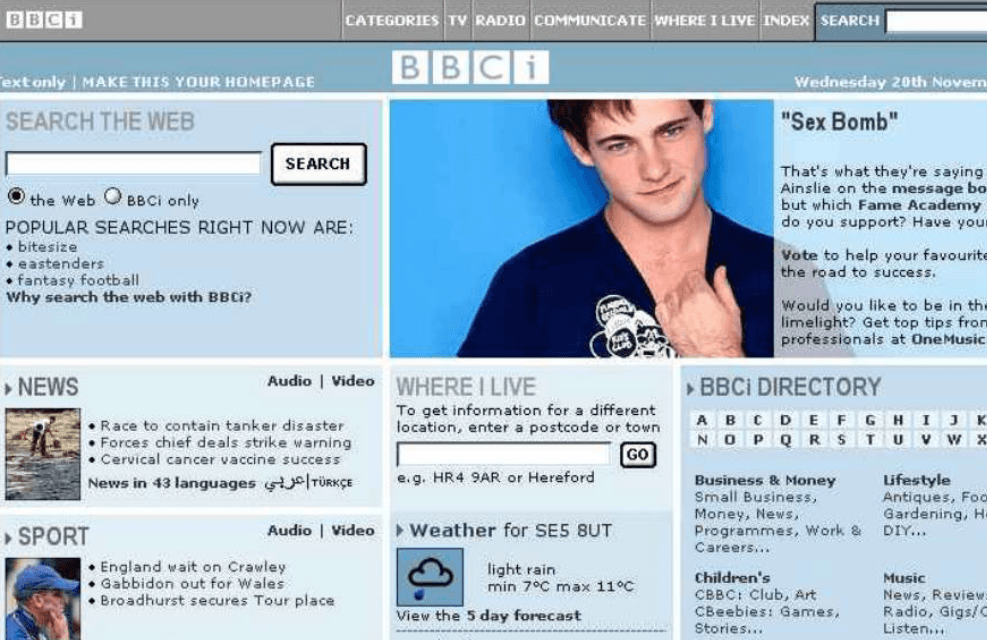

Redesigning an icon for a new age.

In setting out to redesign the BBCi homepage we knew that we were tackling a hard task. Many people use and love the homepage, so we know that any changes we make will evoke a strong reaction.

We needed to balance the needs of these users with the needs of our own business. We needed to satisfy a large number of people with a range of different objectives, both inside and outside the BBC.

Any solution requires us to make decisions, but we made informed choices to ensure a sensitive evolution of the page. We wanted to make a clear step change with the design of the page without alienating the users.

To begin with we looked at the way people use the current page using click-throughs and the way they feel about it through emotional response testing. We looked at how people build up relationships with the services and objects they use on a daily basis.

This helped us address the issues we saw in all elements of the homepage, including the main story. Throughout the process, we benefited from continual user testing and internal feedback.

"The resulting page felt familiar to our existing users, but through digital patina, balanced design and excellent functionality, we also believed that we gave it soul"

Emotional responses guiding emotional design.

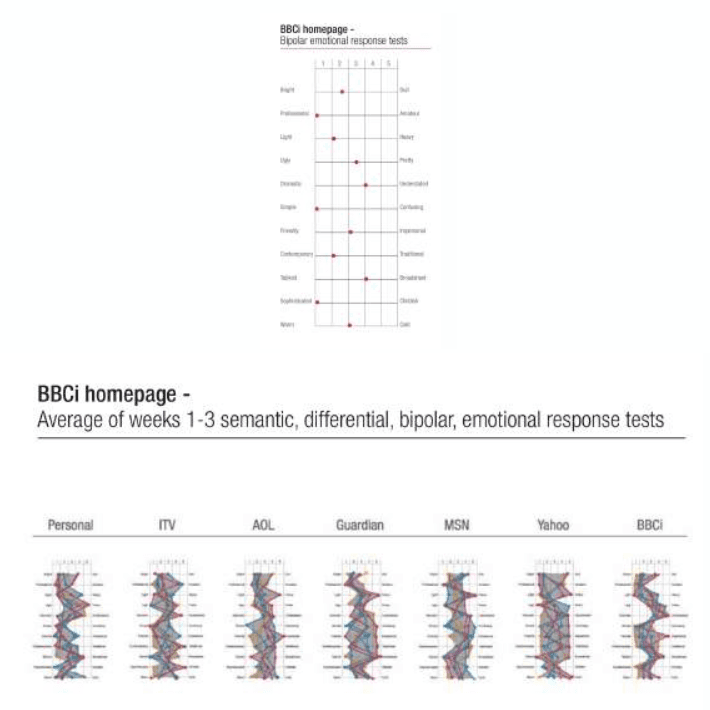
Measuring human emotional response is tricky. How do we know whether interaction with our website will result in the experience intended? What kind of information or inspiration do designers need and how do we get it?

In the example here users were asked to plot their response to an individual homepage using dots. When the responses from all the users were put together they created patterns.

Patterns and shapes can be seen when the emotional response test data is presented graphically. When people's test scores are grouped by site, users' personal favourites and the BBCi homepage look very similar.

Patterns for scores from the other sites varied a lot more in their shape.

Some were thinner and straight with scores concentrated down the median, such as AOL and MSN. We interpret this as an indifference to the visual design. However, people may still like a site based on its functionality and what it does for them rather than how it looks.

Some sites showed more extreme and varied emotional response scores e.g. Yahoo shows a particularly fat even shape. This indicates a strong reaction that is inconsistent between people; their views vary and the way they feel about the look is very different.

From this work we believed that we could gauge in a useful way, reactions to visual design and this would aid the design process.

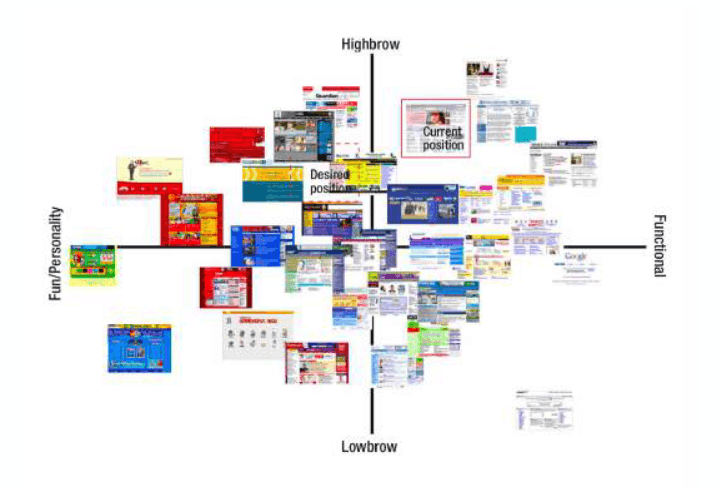
Voice-mapping for directions.

Voice mapping allowed us to look at the design, visual language and brand voice within the space BBCi occupies among its direct and indirect competitors.

The result is a visual representation of our product’s environment and is a great way of seeing how design and visual language can mould and position our own product through comparison with others.

For more details, please see “The Glass Wall BBC Project


Emotional responses guiding emotional design.

Measuring human emotional response is tricky. How do we know whether interaction with our website will result in the experience intended? What kind of information or inspiration do designers need and how do we get it?

In the example here users were asked to plot their response to an individual homepage using dots. When the responses from all the users were put together they created patterns.

Patterns and shapes can be seen when the emotional response test data is presented graphically. When people's test scores are grouped by site, users' personal favourites and the BBCi homepage look very similar.

Patterns for scores from the other sites varied a lot more in their shape.

Some were thinner and straight with scores concentrated down the median, such as AOL and MSN. We interpret this as an indifference to the visual design. However, people may still like a site based on its functionality and what it does for them rather than how it looks.

Some sites showed more extreme and varied emotional response scores e.g. Yahoo shows a particularly fat even shape. This indicates a strong reaction that is inconsistent between people; their views vary and the way they feel about the look is very different.

From this work we believed that we could gauge in a useful way, reactions to visual design and this would aid the design process.

Voice-mapping for directions.

Voice mapping allowed us to look at the design, visual language and brand voice within the space BBCi occupies among its direct and indirect competitors.

The result is a visual representation of our product’s environment and is a great way of seeing how design and visual language can mould and position our own product through comparison with others.

For more details, please see “The Glass Wall BBC Project

Could I be the Design Manager you are looking for?

Could I be the Design Manager you are looking for?

Stephen Hunt

Culture is the beginning of EVERYTHING.

Stephen Hunt

Culture is the beginning of EVERYTHING.